Hoping for the Future of a Country Before Christ Returns

Sunset on Parliament Hill in Ottawa, Canada. Credit: Robbie Palmer, Unsplash.
These Discouraging Times
It seems that I only ever hear discouraging news about my country, Canada.
It was troubling to see the passage this summer of the Combatting Hate Act (Bill C-9) with its repeal of the “good faith” religious opinion defense, along with the prior comment in that context by Marc Miller, our Minister of Canadian Identity and Culture, that, “In Leviticus, Deuteronomy and Romans, there are passages with clear hatred towards, for example, homosexuals.”
This is just one more step along the path toward a society that formally opposes Christianity. As recently as 2018, former Prime Minister Justin Trudeau tried to force businesses and non-profits to explicitly declare their support for “reproductive rights” in order to gain funding for student employment in the summer. Then came the COVID years when churches were deemed non-essential and pastors were arrested for the first time simply on the grounds that they were holding church services.
Things are nowhere near as bad as in the days of Elijah, but I am reminded of his grief over the apostasy of Israel when he said:
“I have been very jealous for the LORD, the God of hosts. For the people of Israel have forsaken your covenant, thrown down your altars, and killed your prophets with the sword, and I, even I only, am left, and they seek my life, to take it away.”
I want to hope for better things — a day when Canadians turn from the lies of Satan and embrace Christ as Lord, when they rejoice in the truth and show genuine love toward one another.
However much Canada deserves judgment for its many sins, I want God to spare us.
Yet I find myself wondering, “Is it realistic to hope for better days?”
After all, it is one thing to “set your hope fully on the grace that will be brought to you at the revelation of Jesus Christ” [1 Peter 13]. That hope is certain.
But what about hoping for the future of my country in the time before He returns?
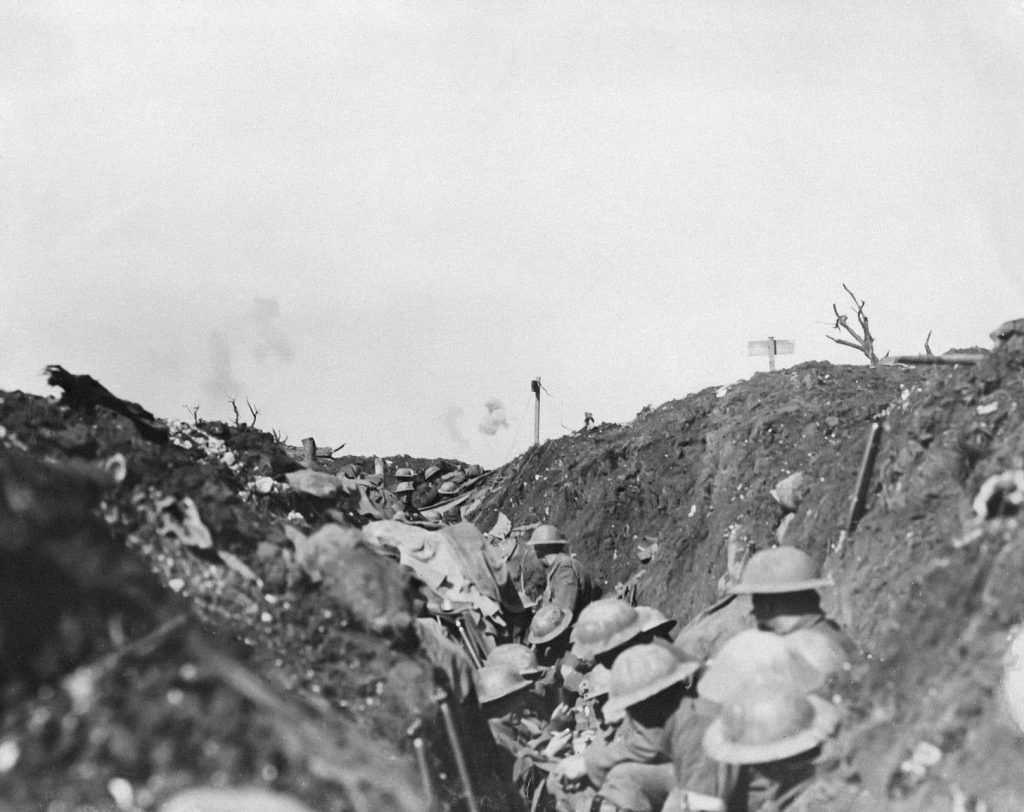
Shrapnel bursts over a reserve trench in the Canadian lines, ca. 1916. Source: Provincial Archives of Alberta (G. Harrisson Villett fonds, PR2004.0125/53).
The End of All Things
There have been times when things seemed so bad that there was no hope for the future of any country except the return of Christ.
One such occasion was the First World War.
For some decades prior to its outbreak, Western observers had warned of a day when Europe would be plunged into a battle of such terrifying proportions that civilization itself would be brought to an end.
In 1890, German Chief of Staff Helmuth von Moltke spoke of “the war that has been hanging over our heads now for more than ten years like the Sword of Damocles.” In 1897, Polish banker Jan Bloch wrote of “the war that has haunted the imagination of mankind for the last thirty years.” American political scientist Paul Reinsch warned just a few years later that a time had come in which “grim, silent, passionate forces will hurry humanity along, like leaves in a torrent.”
Then, on August 3, 1914, the day before Britain declared war on Germany, British Foreign Secretary Edward Grey remarked to a friend, “The lamps are going out all over Europe; we shall not see them lit again in our life-time.”
The unprecedented violence and enormous scale of the subsequent conflict led some Christians to conclude that the return of Christ was imminent.
In 1917, for example, several leading ministers in Britain issued a statement called “The Present Crisis: The Lord is at Hand.” In it they declared the following convictions:
1. That the present crisis points toward the close of the Times of the Gentiles.
2. That the revelation of our Lord may be expected at any moment…
In 1918, R. A. Torrey, dean of the Bible Institute of Los Angeles (today’s Biola University), expressed a similar sentiment:
…these are just such days as God tells us will precede the rising of the Morning Star… the glorious coming of King Jesus…[pg14]
It is certain that we are fast hurrying toward the end, fast hurrying toward that dark night that shall precede the sunrise. [pg16]
Nevertheless, the Lord did not return in the First World War. Nor did He return during the greater calamity of the Second, nor even at any point during the much longer Cold War with its perpetual threat of global annihilation.
Here we are in the year 2026 and the end has not yet come.
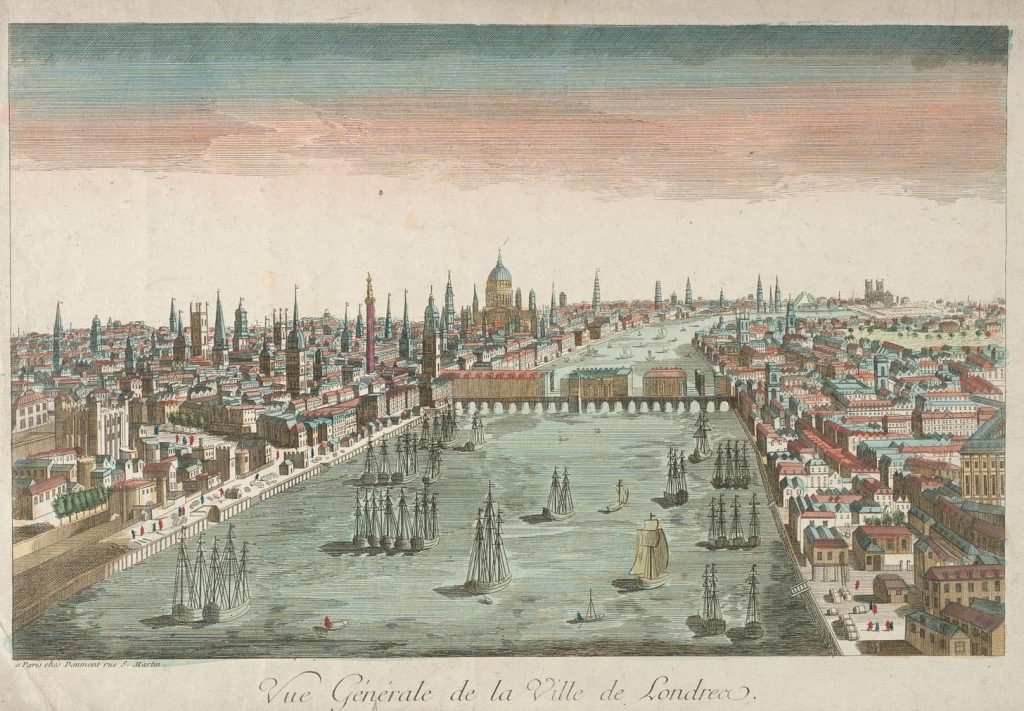
London in the 1700s. Source: The Cleveland Museum of Art (1925.605).
Return from the Darkness
If Christ did not return when things were exceedingly bad, then perhaps He will not return anytime soon, either. In that case, we ought to look to the wellbeing of society in our own generation — and for the sake of those to come.
But can a society that has rejected Christ ever truly return to Him?
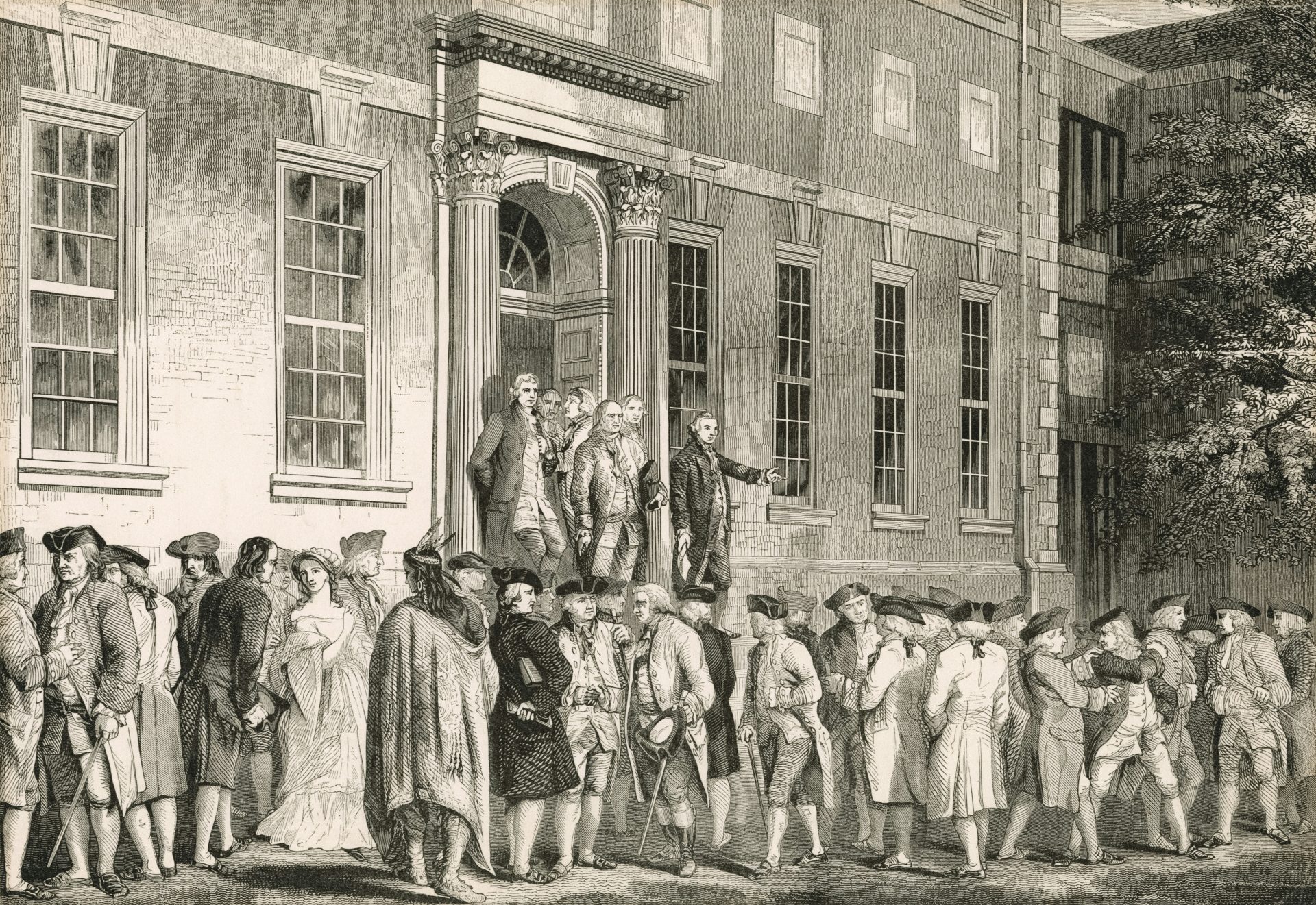
I recently started reading J. C. Ryle’s The Christian Leaders of England in the Eighteenth Century. Though Ryle was writing in 1868, he was looking back to the 1700s. I was shocked by the similarities between that England and my own country today.
Listen to how Ryle describes it:
“Morality, however much exalted in pulpits, was thoroughly trampled under foot in the streets. There was darkness in high places and darkness in low places — darkness in the court, the camp, the Parliament, and the bar — darkness in country, and darkness in town — darkness among rich and darkness among poor — a gross, thick, religious and moral darkness — a darkness that might be felt.”
Although England was “a land of free Bibles and professing Protestantism,” the sermons “were little better than miserable moral essays” and consequently “the land was deluged with infidelity and scepticism.” Christianity, seen as a mere fiction, was widely ridiculed. Anything that could not be reasoned on the basis of “natural light” alone was despised.
Of morality in general, Ryle writes:
“It may suffice to say that duelling, adultery, fornication, gambling, swearing, Sabbath-breaking and drunkenness were hardly regarded as vices at all. They were the fashionable practices of people in the highest ranks of society, and no one was thought the worse of for indulging in them.”
But he also says that things had dramatically changed in the intervening years:
“I believe that our own times are the best times that England has ever seen. I do not say this boastfully. I know we have many things to deplore; but I do say we might be worse. I do say that we were much worse a hundred years ago…
We see and feel evils to which, a hundred years ago, men were insensible. We struggle to be free from these evils; we desire to amend. This is a vast improvement. With all our many faults we are not sound asleep…”
Let us thank God for this!
Is not the West today like the England of the 1700s?
Though Bibles are freely available, Christianity is widely seen to be a fiction. People delight in their sin and scoff at the notion that their desires could be sinful. They exalt human emotion and naturalistic science above all other authorities.
How does a society come back from that?
Ryle explains how it happened in England:
“The men who wrought deliverance for us, at this period, were a few individuals, most of them clergymen of the Established Church, whose hearts God touched about the same time in various parts of the country… They were simply men whom God stirred up and brought out to do his work, without previous concert, scheme, or plan…
They taught one set of truths. They taught them in the same way, with fire, reality, earnestness, as men fully convinced of what they taught.”
Even though these men were derided by influential people, shunned by the church, and regarded as fanatics, Ryle says they persevered. Ultimately, many people repented and turned to Christ, and “the feeling of all classes in the land about religion and morality gradually assumed a totally different complexion.”
“When God takes a work in hand,” he concludes, “nothing can stop it. When God is for us, none can be against us.”
Too Much to Hope?
Is it too much to hope for better days in Canada?
Is it too much to hope that true Christianity will prevail?
Yes, it is too much, if we will not work in God’s ways. If we are ashamed to name Him and associate with Him, if we cannot speak of Him “with fire, reality, earnestness, as men fully convinced,” then there will be no better days.
If we will not obey Him and teach others to do the same, there will be no better days.
But if God will touch the hearts of people across the country, stirring them up to glad and fearless faith, then, yes, we can hope!
We are completely dependent on the Lord to act. So, as we fulfill our part in these times, let us pray and keep praying. No matter how troubling and evil the news, we must not despair. Remember that God has once restored a formerly Christian country from abject darkness. Canada — and the West more broadly — can never be so lost that He cannot bring them back to the light.
Then rose up the heads of the fathers’ houses of Judah and Benjamin, and the priests and the Levites, everyone whose spirit God had stirred to go up to rebuild the house of the LORD that is in Jerusalem.
May the Lord have mercy and raise up your country for the sake of His name!