We live in a world obsessed with comfort and the casual. Pajamas, no undergarments, and fluffy house shoes are considered appropriate public wear. This obsession with comfort extends beyond just what we wear but also how we think, act, and relate to one another. Relationships are casual. Dating and courtship have been traded for hookups and co-ed living. Proper speech is increasingly replaced with slang and empty repetitive phrases like “no, yeah,” and “you know what I’m saying?” Moments of deep contemplation and planning have been outsourced to bumper sticker philosophy, podcasts, and influencers who tell us what to think— so long as it’s not longer than 5 minutes or 280 characters.
Christians, more than anyone, should swim against the tide of these new cultural norms. Christianity is an old, deep, and thinking religion. Whether we eat or drink, or dress, we ought to do everything for the glory of God. Our faith should breed excellence, not mediocrity. Our examples, Christ and the Apostles, were not men obsessed with comfort, but went after the good, true, and beautiful. There should be something about how we look, speak, act, raise our families, and live our lives that is in stark contrast with the world. We should be different.
Right now, more than ever, a simple way of achieving this is elevating how we dress by rejecting the casual dress and conserving the classic wardrobe of yesteryear, which dignified every class, making clear distinctions where men looked like men and women looked like women.
Against Cosplay
There can be a temptation when looking to conserve something of the past to fall into a sort of historical cosplay. This has been seen in some of the trad-wife movement, with women dressing in an obviously 1950s style, with 1950s style kitchen equipment and music playing in the background. We are looking to conserve, but not reenact.
This means there should be general principles, but not specifics. God has made us each unique and placed us in various locations with distinct cultures, each with a different sense of aesthetics. Some types of clothing are perfectly normal in one area, such as bolo ties in the West and seersucker suits in the South, which are inappropriate in other areas. There is also a deeply personal aspect of our appearance, not only in what we like, but what looks good. For example, I love plaid flannel shirts, but they don’t love me.
If you consider your own style and apply these basic principles, you can elevate your appearance without looking like you just stepped off a 1940s movie set.
Character Counts
Possibly the most understated aspect of a classic wardrobe is a man’s character. Part of the modern anti-feminist movement with men is that they believe that shooting guns, growing a beard, and wearing flannel make them a man. Meanwhile, they can’t form a coherent sentence, usurp their duties in their homes like boys, and are, in general, a “bunch of knuckleheads.”
It does you no good to dress like a man yet act like a boy, or worse, a girl.
General Principles:
- Say “please” and “thank you”
- Hold the door open for women and open the car door for the lady in your life
- Look people in the eyes when you talk and shake hands
- Have a firm handshake, except with women
- Avoid slang and foul language
- Speak confidently with sufficient volume, but never shout
- Don’t drag your feet
- Sit and stand up straight
- Be alert and aware of your surroundings
- Treat everyone with dignity and respect, even if they don’t return the favor
- Be punctual – being late is stressful on those following you and disrespectful to those waiting on you
The Suit
The suit is defined by a matching jacket and pant made of the same material and color, typically wool. It is the epitome of classic and masculine men’s wear. Designed to accentuate and broaden the shoulders and bring in the waist for a manly V-profile, a properly fitted suit will make skinny men look more muscular and larger men more trim.
It’s said every man should own a suit, but I find that it is deeply dependent upon the person. Suits are expensive, often hitting the $1000 mark for something of decent quality. Given the increasingly casual nature of our culture, a suit is becoming more and more uncommon and over the top in most situations, and may be an unneeded expense. I have found that a capsule wardrobe can cover the vast majority of occasions without having to shell out for an item you may only wear a handful of times.
If you find you need a suit, don’t skimp and get properly measured. Stick with versatile colors such as gray or navy, and in general, avoid patterns such as pinstripes or windowpane. You may love the look, but most people associate pinstripes with 1920s gangsters and sleazy car salesmen. Not the impression you want to make.
The Capsule Wardrobe
Most men are sloppy dressers because they don’t like to think about what they’re going to wear. We men are utilitarian in most things, so if it fits and is comfortable, that’s all that matters. However, that doesn’t mean we are relegated to graphic tees, basketball shorts, and Crocs. You can build a minimalist wardrobe that allows you to pick any item of clothing at random, and it will always look sharp. This is called a capsule wardrobe. This will require purchasing a number of items, especially if you are starting from scratch. However, the items do not necessarily need to be the most expensive brand you can find. There are several ways to save money, but the focus is on quality, not quantity.
For your capsule wardrobe to be as versatile as possible, you must have items that will match every occasion, from a workday to Sunday morning to weddings and dinner parties. It also needs to cover the seasons of the year. This will look different depending on your location. This is achieved through a few classic colors and clothing items. Sticking with colors that are both masculine and complementary is key. Stick with earth tones: white, gray, brown/tan, green, blue, and occasionally red. Avoid intense, brightly colored, and neon items or flamboyant patterns.
Tips for sizing:
- Check the collar. It should be large enough to button all the way up without choking you.
- Check the sleeve length. Sleeves that are too long make you look sloppy, too short, comical.
- Check the length. Ideally, you want the shirt to come down mid-thigh. This will allow you to tuck your shirt in but not have it constantly come out when you sit down and move around.
- If you wear a wrist watch, make sure your cuff is large enough to slip over your watch. Some custom shirt makers will give you the option to have a larger cuff on one sleeve to allow for a watch.
- These same rules apply to jackets and pants. The opening of your pants leg should break cleanly just below your ankle, no Michael Jackson pants or 90s baggy jeans. Shorts should come just above the knee. Check the sleeves on your jacket, preferably with one of your shirts on. It should break right around your wrist bone, allowing approximately a ¼” of your cuff to show. Off-the-rack jackets will be labeled L for long, S for short, or R for regular. A jacket should easily button and be comfortable through the chest and shoulders
The Polo Shirt
If there was only one item of clothing to buy to elevate your current right now, it would be the Polo. Defined by its open-weave cotton pique fabric, soft collar, elastic cuffed short sleeves, and 2-button front, it elegantly straddles the casual nature of a t-shirt and a formal dress shirt with buttons and a collar. Wear it with jeans, shorts, chinos, or even a jacket in the summertime, dress it up or down, and you will rarely be over or underdressed for the occasion.
While there is a wide variety of colors and fabrics, stick with the classic cotton pique and more muted solid colors such as navy, gray, and white for the most versatility.
The Oxford Shirt
Classic, sharp, and versatile. The Oxford Shirt, originating at Ivy League campuses, is characterized by its substantial, slightly textured cotton fabric, a soft button-down collar, soft single-button cuffs, a single breast pocket, and a soft front placket. If you live in a warmer climate, look for a linen/cotton blend. In more temperate to colder climates, go for the full cotton heavyweight original. Every man should have at least two Oxford shirts: light blue and white.
The Oxford is dressy enough to wear to church or dinner with slacks and a blazer, and casual enough to wear with jeans and boots to elevate your everyday wear. Roll the sleeves up in warmer weather for a more casual look without sacrificing the sharp look of a collared shirt. Their substantial fabric means they will last for years and only get better with wear.
Since the Oxford has soft features that lend to a more casual appearance and feel, avoid wearing a tie with this one.

Blue and white striped Oxford with Navy Hopsack blazer. Note the soft button-down collar that defines the Oxford
The Dress Shirt
Inevitably, you will have more formal occasions where you need to wear a tie. This requires a shirt that matches the occasion.
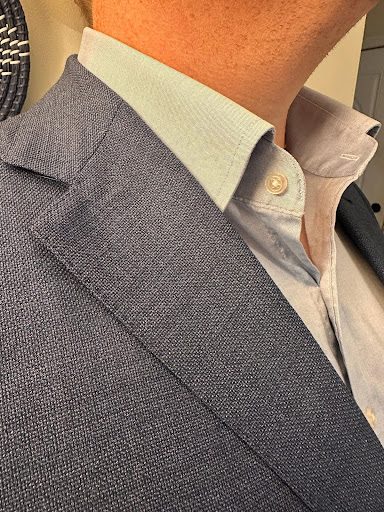
In general, a dress shirt will be a solid color, have a structured, more stiff collar that does not button down, a smoother, thinner, and usually softer fabric, sometimes with a sheen, no front placket, and a more structured single or double button cuff. Like the Oxford, every man should own a solid light blue and white dress shirt.
Variations are possible with dress shirts. Pattern shirts are more casual than solids, and certain features can elevate the formality of the shirt, such as with or without pockets (without is more formal), the collar and cuff type (softer cuffs being less formal and French cuffs being the most formal), and soft, standard, or no front placket (this gives a cleaner, more formal look).
Once you begin to understand these concepts, it really allows you to customize your items to make them more versatile. A gingham dress shirt, with a spread collar, standard placket, single button cuff, and no pocket, can be worn with jeans and a denim jacket, or a blazer and tie.
Light blue dress shirt with navy Hopsack blazer. Note the difference in fabric and the more structured spread collar.
The Chino Pant
Much like the Oxford shirt, the Chino is the perfect do-it-all pant. Often made of cotton, it is a cross between jeans and dress slacks by having a visible seam on the legs and hems and 5 pockets like jeans, while being constructed with a smoother and lighter fabric more akin to dress slacks. Many brands blend their Chinos with a small amount of elastic, giving them a subtle stretch. This makes for an elevated pant that is often more comfortable than jeans.
Keeping with the theme, Chinos can be dressed up or down—as much at home with a t-shirt or polo as with a jacket and tie. At a minimum, have a pair in gray and khaki. If you’re more adventurous, oxblood/burgundy and olive green are great, yet still versatile colors.
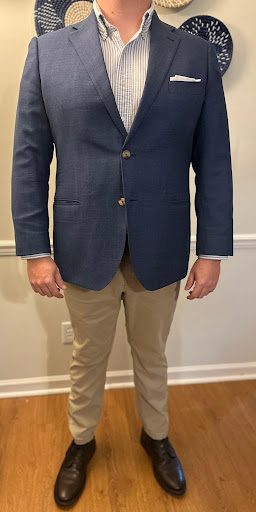
Blue and white striped Oxford, navy Hopsack blazer, white pocket square, Khaki Chinos, and coffee dress boots. Note how the sleeves of the shirt and blazer do not extend over the hand, with a small amount of the shirt cuff exposed.
The Dress Pant
Similar to a dress shirt, the dress pant is for more formal occasions. Defined by their clean appearance, no visible seams or pockets, a clean hem, and typically smooth wool fabric, they bring an undeniable amount of class to any occasion. Save these for more formal occasions and don’t try to dress them down or you will risk looking awkward. Use these to elevate your look. At a minimum, one medium gray pair.
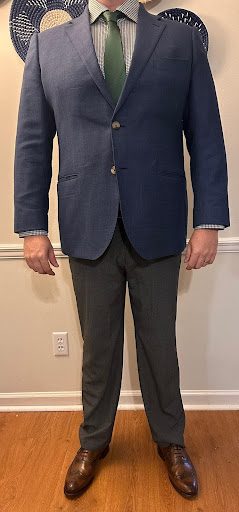
Navy and Green tattersall dress shirt, green silk tie, navy Hopsack blazer, gray dress pants and chestnut brogues.
Jeans
Some purists may balk at the addition of jeans, but again, we are not looking to cosplay, and jeans are quintessentially American and classic. A nice pair of dark wash jeans are very versatile and look great on everyone. They can be dressed up with a sport coat and plaid shirt, or a more casual, but polished look, with dress boots or brogues and a polo. By adding more elevated elements to jeans, you can still bring a polished look without making the other people in the room, or your lady, feel underdressed. The key is the dark wash and proper fit. Opt for a slim or tailored fit. Save your baggy, faded, ripped jeans for work.
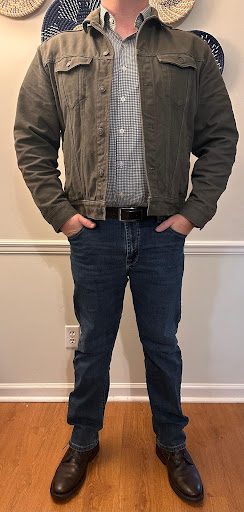
Green and navy tattersall dress shirt, olive green canvas trucker jacket, dark wash jeans and coffee dress boots.
The Blazer and Sportcoat
Have two coats for all occasions. A blazer is typically defined by not having a matching pair of pants, as with a suit, and a light to moderately textured wool or linen fabric. Blazers come in all sorts of colors and fabrics, which dictate their formality. The classic navy blazer with gold buttons is possibly the more formal, while lighter colored linen blazers are more casual. In general, the darker the color, the more formal, and the lighter the color, the more casual. For the most versatility, go for a medium blue with brown buttons, preferably in a nicely textured fabric like Hopsack. The texture will allow you to dress it down with jeans or a polo, or dress it up with dress slacks and a tie.
Sportcoats are the more casual brother of the blazer. Depending on your location, this may be a seasonal item. Typically of thicker and more textured fabric, such as tweed or brushed wool, it may or may not have leather patches or fabric reinforcements on the elbows and shoulders, and flaps over the pockets. Sportcoats are a great way to elevate your appearance without sacrificing functionality and durability. Originally designed for hunting and being in the elements, they will hold up to most activities and look good while doing it. Due to their more casual nature, wear a sportcoat to elevate casual outfits. Do not pair with dress shirts or pants.
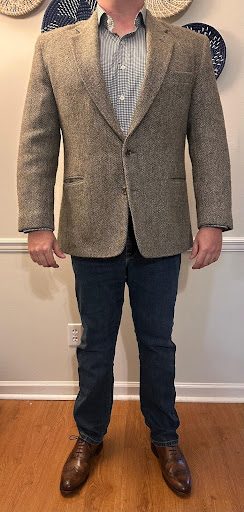
Harris tweed jacket over a navy and green tattersall dress shirt, dark wash jeans and chestnut brogues. Note how this 1 tattersall shirt is used in 3 different outfits, dressed up and down.
Shoes
Shoes are an often overlooked part of a men’s wardrobe, but it is one of the first things women notice. A pair of shoes can make or break your entire appearance. In general, you want a pair of both black and brown shoes, preferably leather. However, if you never find yourself attending very formal or black tie events, you can get away with 1 pair of brown shoes. Just like the other clothing items, the color, fabric, and design of a shoe dictate their casual or formal nature. The more stitching, texture, and less uniform color, the more casual. The cleaner, smoother, more uniform color, the more formal. Whole cut black leather oxfords are very dressy and only appropriate for black tie and the most formal occasions. Suede derbies are the most casual.
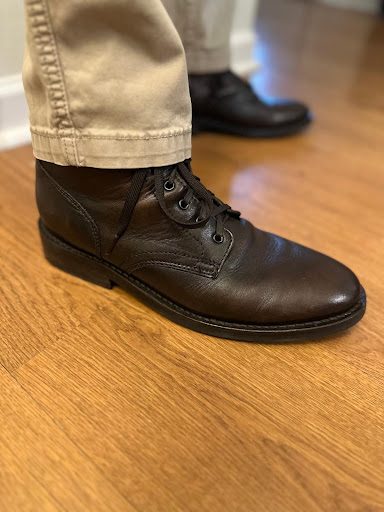
A particularly versatile shoe is the Brogue. Originally designed in Scotland, it was a hunting shoe with perforated holes that allowed water to drain out and straps to tie around the calf to hold the shoe on when wading through bogs. Now they hold the line of formality and casualness. Easily dressed up with a suit and a tie, and just easily dressed down with jeans and an Oxford. Another great option is brown dress boots, which are just as capable as brogues. When picking a shade of brown, tend toward the medium to dark color options. This helps hide scuffs and scratches and will allow for more formality if needed.
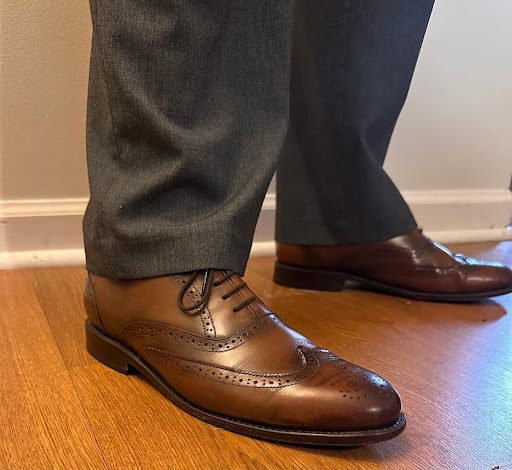
Chestnut Brogues from Thursday Boots
Coffee dress boots from Thursday Boots.
Belts
Always wear a belt. Not only does it add an extra layer of “put together” to anything you wear, but as a man, it’s useful for many things, from a tourniquet to sharpening a knife, and especially keeping you from “looking like a fool with your pants on the ground.” In general, do your best to match your shoes and watch strap if you have one. Keep both a brown and a black belt to cover any occasion.
Don’t skimp on your belt. Avoid anything that says “genuine leather” (which is almost always a sign of low quality) or any other questionable material. If it doesn’t look, feel, and smell like good leather, avoid it. Skip Walmart or your local department store and purchase a high-quality full-grain leather belt. It will pay for itself in the long run.
Watches
There is some debate about men wearing wrist watches. Wrist watches did not become common for men to wear until WW2, when soldiers and pilots came home with their military wrist watches used for timing attacks. Since a pocket watch looks ridiculous and trivial for most people, and a wrist watch has been ubiquitous for almost 100 years, it is a safe, sensible accessory to wear. A watch communicates punctuality.
You can spend as much or as little on a watch as you would like, but for our purposes, it is best to stay with something classic and versatile. A steel case, hour and minute hands, and a steel bracelet or leather strap. Don’t wear a G-shock or similar watch except in the most casual environments. Details are what distinguish a truly classic and mature appearance, and an orange G-Shock under your dress shirt cuff looks childish.
One mistake I often see with men is watches that are too big for their wrists. Most companies will list the case diameter of any particular watch. An appropriate size for the average man is 36-40mm. If you have particularly small wrists, 6” and under, stay in the 34-38mm range. If you have large wrists, 7” or larger, you can afford a larger watch, if you prefer, into the 44-45mm range and not have it look silly.
Before buying a watch, pay attention to water resistance. Despite what seems logical, a watch that has a 50m water resistance does not mean you can swim 50m without damage. A watch with 50m water resistance is the bare minimum I feel comfortable with for everyday use. This will allow you to wash your hands, give your child a bath, and perform normal day-to-day activities without much worry. If you wish to be able to shower and swim, 100m is the safe minimum. If you want to do anything and everything, never having to worry about water, a diver’s 200m is the minimum.
Like the other items, you can get a decent dive watch on a steel bracelet that will cover every occasion. Stick with a mostly brushed finish over high polish, and a black or blue dial. In general, avoid extravagant dial colors and gold-tone cases/bracelets to prevent clashing and gaudiness.
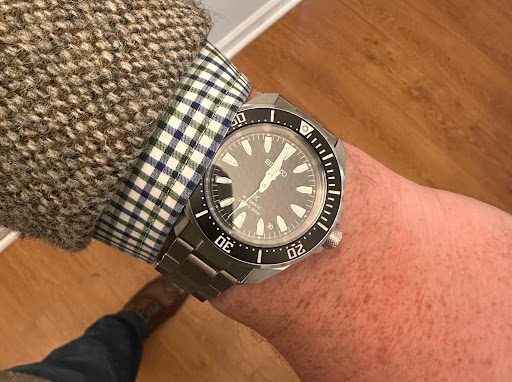
Seiko mechanical dive watch on a steel bracelet.
Neck Tie/Pocket Square/Socks
You should always have a few neck ties on hand and a pocket square. You never know when your suave, gentlemanly nature will bring a tear to your lady’s eye, and a pocket square at the ready is the perfect thing to offer.
Ties are a point of personal preference, but in general, it is safe to stick with solid colors. They always look clean and elegant. For most occasions, avoid outlandish colors. Dark blue, green, red, or violet will cover most things. If you prefer a pattern, keep it simple. Overly floral patterns look androgynous, and loud colors or patterns will call attention to yourself. The same rules apply with pocket squares; a simple complementary color will do the job. You can never go wrong with a simple white cotton square.
There are more casual knitted and wool ties that go well with tweed and sports jackets, but avoid mixing with fabrics. If you’re wearing a blazer, go for silk. If tweed, go for the knit or wool. If you’re wearing a sportcoat, forget the pocket square.
When putting on your tie, make sure the tip of the tie is neither too long or short to avoid looking silly. The tip of your tie should barely touch your belt buckle. If you’re like me and have a thick neck, you will find you need to buy an extra-long tie to achieve the proper length.
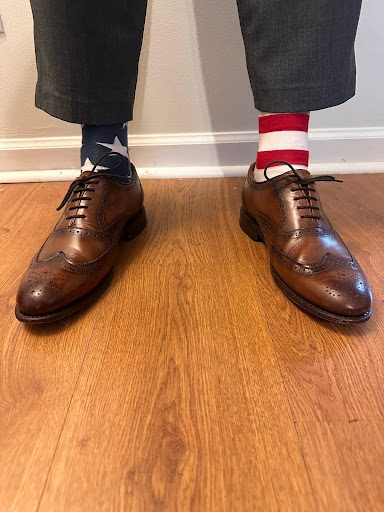
As far as socks go, solids are always the safe bet, but don’t overlook classic patterns like argyle, which can bring a real class for the discerning eye. For the one who likes to have fun (dressing like a gentleman doesn’t have to be boring), seasonal and printed socks are a great way to add a personal touch, especially on holidays, without being flamboyant, since they are typically only exposed when sitting down. However, context is key.
Don’t wear your Snoopy socks to a funeral or wedding.
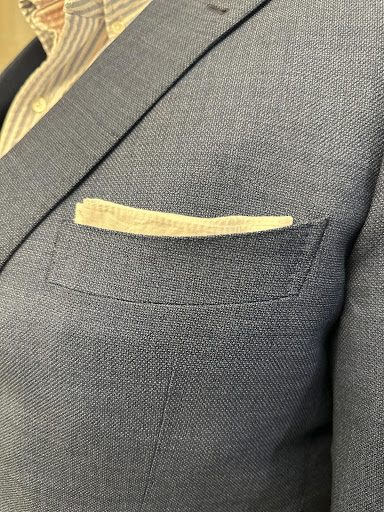
A simple white cotton pocket square adds instant class to any outfit.
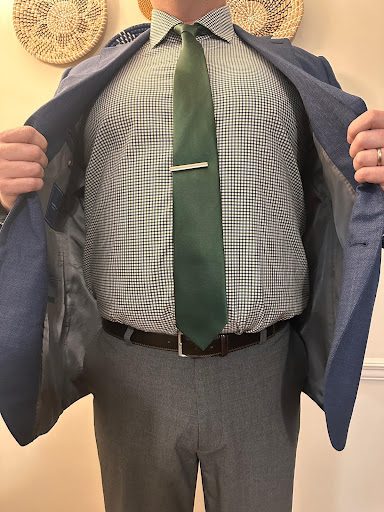
Note the length of the tie. A simple brushed steel tie bar keeps everything in place.
“Oh beautiful for spacious skies..”
Hot Weather
If you live in an area where hot weather is a serious issue, you don’t have to settle for athletic wear. You can stay cool while keeping your look classy. Linen or linen blends are your friend. Trade chino pants for chino shorts, long sleeve button-ups for short sleeve linen button-ups or a polo, and dress shoes for boat shoes. If you’re against shorts, look for linen or tropical wool dress pants. Although more difficult to find, you can also find seersucker, which is a fabric with an open puffy weave that keeps the fabric off your skin and allows air flow. You can find suits and shirts made in seersucker, but these are unapologetically casual. Go for the solid colors and not the original blue and white striped pattern unless you can really own it. Avoid cargo or denim shorts.
Affordability
There is no way around it, dressing this way is more expensive up front, but higher-quality clothes last longer. However, it doesn’t have to leave you in debt. Purchasing one item at a time will spread out the cost and make it easier on most, and looking for gently used items is a great way to save money. Harris Tweed jackets can be had second-hand on eBay for a fraction of the cost of a new. With a good local tailor, a button-up shirt from Walmart can look and wear like a $100 shirt elsewhere. Sometimes you can scour thrift stores for quality dress shoes, which can be sent to a cobbler and made virtually new for far less than a brand-new pair.
Make sure you love the way something looks and fits before buying. A $30 shirt you wear once is more expensive than a $100 shirt you wear every week for years. Buy what you like, the best you can afford, and get it tailored. The highest quality shirt that does not fit is also a poor investment.
If you are looking to buy new but still not break the bank, here are a few I recommend:
- Thursday Boot Company or Beckett Simonon for shoes and belts.
- Propercloth for custom-made shirts, jackets, and suits.
- eBay for tweed jackets
- Timex, Seiko, or Citizen for watches
- Walmart for Chinos and dress pants
Conclusion
You don’t have to take out a second mortgage to raise the standard on your wardrobe, and you are also not forced to accept sweatpants and slides as proper dinner attire.
Take your time and shop around. Find what appeals most to you and glorify God in it.
Photo Credit: Unsplash